|
SACRIFICE OF IMAM HUSAIN (A.S.)
The Grandson of Holy Prophet Muhammad (S.A.W.W.)
By: Ra’isul Mubalighin Allamah Sayyid Saeed Akhtar Rizvi
R.A.
This week millions of Muslims all over the world are
commemorating the great martyrdom of Imam Husain, the
grandson of the prophet of Islam, on the plain of
Karbala (Iraq) [1365] years ago.
Imam Husain’s aim was to save Islam from the disastrous
clutch of Yazid, who claimed to be the ruler of Islam
but whose debauchery was a poison to Islam and its
tenets.
Yazid openly declared his disbelief in the Holy prophet
of Islam and his mission, ridiculed the belief of the
Day of Judgment, made fun of the Islamic prayers; liquor
was the common drink in his gatherings, gambling was the
order of the day; he indulged in incest with
step-mothers and aunts.
Yazid remained in power less than four years; and during
this short period his armies attacked Madina and Mecca,
the two holiest cities of Islam. In Madina, he killed
700 reciters of the Qur’an and hundreds of the
companions of the Holy prophet; thousands of women
became victim of his army’s lust: the Holy Mosque of the
prophet was turned into a stable; people of Madina were
required to swear allegiance in these words: “We are the
slaves of Yazid; it is up to him either to set us free
or to sell us in the market.” Those who he stated were
at once beheaded. Mecca was besieged; burning wood was
thrown onto the Holy Ka’aba, and a part of it was
demolished.
It was inconceivable that Husain would give his consent
to the rule of such a beast. Husain was son of Ali and
Fatima, grandson of the Holy prophet of Islam who had
said about him: “Husain is from me and I am from
Husain”, and “Hassan and Husain are the chiefs of the
youths of paradise”.
Yazid wanted Husain to accept him as the bonafide Caliph
of Islam; Husain cold never agree to it. To do so would
have meant accepting all the evils of Yazid as part of
Islam. Islam could not survive as a religion if Imam
Husain would have put his seal of approval upon Yazid
and Yazidism.
Imam Husain knew very well what he would have to endure
as a result of his refusal to submit to Yazid. But he
was not after worldly power or material gain, which
could be abandoned in face of insurmountable
difficulties. He had risen for the cause of Islam, and
dangers could not subdue his indomitable spirit. He made
his aim perfectly clear in his will, which he wrote at
the time of departure from Madina.
He wrote; “I am not leaving Madina because of any pride
or worldly motive. I am leaving it so that I may follow
the path of my grandfather (the Holy Prophet) and father
(Ali) and so that I may exhort people to be righteous
and may dissuade them from evil”.
He was frequently heard reciting these two verses during
his journey to Iraq: “If the religion of Muhammad cannot
be saved, except by (sacrifice of) my head then O
swords, come and take it”.
And to save the religion of Prophet Muhammad (s.a.w.w.)
he sacrificed not only one but 72 heads.
Before he could reach Kufa, he was met by a contingent
of 1000 soldiers of Yazid, who were advancing to
intercept him. The midday sun of Arabia had set the
desert ablaze. Not only the soldiers but even their
horses were half-dead because of unbearable thirst;
their water was spent long ago, and they could not get
water anywhere during their march.
Perhaps it would have been easy to let the enemy die of
thirst. But it was not the way of Imam Husain .He was
fighting against immorality; he could not adopt immoral
and un-Islamic methods to gain victory. He ordered his
companions to give water not only to the soldiers of
enemy but even to their horses.
Ultimately, Imam Husain was encircled in Karbala. He and
his children and companions were denied water for three
days. On 10th Muharram, the fateful day, all his
companions and relatives (72 in number) valiantly fought
against an army 32,000 strong, and were martyred; even
his six-month old son was put to death.
Finally Imam Husain, after three brave encounters
against enemy, was martyred in the cause of Islam. On
that last day of his life, when every passing moment
brought a new suffering and presented a new tragedy,
Imam Husain’s face radiated more and more with content
and joy. He was happy that his offerings were accepted
by Allah.
After his martyrdom, his head was raised on a spear; his
women folk were imprisoned and, after much suffering,
were brought to the durbar [palace] of Yazid at
Damascus. But the determination of these captives, like
that of Imam Husain, was never
weakened.
The life and death of Imam Husain are the perfect
example of this ayat of the Qur’an: “Say, truly my
prayer, and my actions, my life, and my death are all
for Allah, the Cherisher of the universe.” (6:162)
Thus Imam Husain showed how a Muslim should live for
Allah, how he should die for Allah. Such a death is not
death; it is eternal life, as Allah has said in the
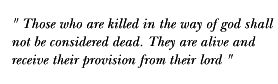
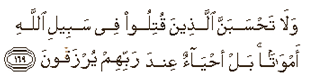
Qur’an: “And do not think those who are killed in the
path of Allah are dead. Nay, (they are) alive in the
presence of Allah they are given sustenance…”
(3:169)
The value of a sacrifice depends upon its purpose. If
the purpose of sacrifice is, for example, worldly power
or wealth, it cannot result in eternal life. How can a
life be immortal if it was worthless enough to be
bartered for some glittering stones? Gold and silver are
not immortal; they cannot make a life immortal. But if
the purpose of the sacrifice is the Immortal Allah, then
the martyr becomes immortal. When a person is martyred,
witnessing the Glory of Allah, when he accepts death in
the Love of Allah then the sacrifice is worthy of its
name. Death cannot conquer such a soul. As Allah Himself
is Eternal and Immortal, the life spent in His way
acquires
immortality.
It was this unblemished love of Allah, which prompted
Imam Husain to say in the last moments of his earthly
life: “I forgot and left every thing in Thy love, O
Allah, And I made my children orphan so that I may see
Thee; Even if my body is minced (by swords) and pierced
(by spears), My heart would never incline but towards
Thee.”
|